"North by Northwest"-- The Anatomy of the Film

This Analysis Contains Spoilers
********
This not a review of the classic Hitchcock film, but rather an analysis of the film from the perspectives of a film student and/or film maker, based on three crucial questions regarding the film. I may do a review of the film at some point, but it would be positive as the film is extremely well made and entertaining. It came out in 1959 but in no way feels dated. This is due in large part to Hitchcock's visionary film making. His groundbreaking techniques have influenced modern film makers and things that may seem common and ordinary in film now, were quite new and unusual in Hitchcock's day.
I hope you enjoy this analysis.
***********
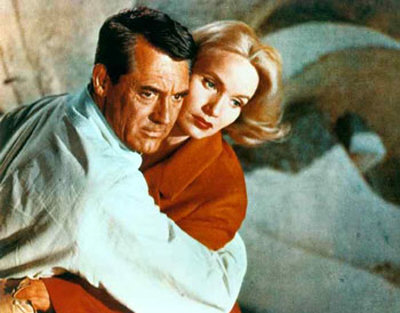
The basic plot of the film revolves around a Madison Avenue film executive named Roger O. Thornhill (Cary Grant) who is mistaken for someone he is not (a federal agent) and is nearly murdered. he sets out to clear his name and find out who has set him up and why.

North by Northwest
Directed by Alfred Hitchcock.
MGM, 1959
Starring:
Cary Grant as Roger O. Thornhill
Eva Marie Saint as Eve Kendall
James Mason as Phillip Vandamm
Martin landau as Leonard
Leo G. Carroll as The Professor
***********
Official Trailer

Question 1.
Based on the opening five minutes of the film, what do we learn about Roger Thornhill and how does Hitchcock use these characteristics against him throughout the film?
We first see Roger Thornhill rushing from his office to a taxi on the way to a hotel to have drinks with some friends (business colleagues) of his. With him is his secretary who’s frantically taking notes that Roger is dictating to her. Thus, our initial impression of Roger Thornhill is a sense of him being a man of some importance and busyness (after all, if one is not busy or important, one would not have a secretary).
We also learn that he is a fairly heavy drinker.
The most striking thing we learn, however, is Thornhill’s cavalier attitude towards the truth. When he directs his secretary to mislead a client she objects saying that’s untruthful. He responds by saying that there is “no such thing as a lie, only an expedient exaggeration.” This leads me to believe that Thornhill may not be entirely trustworthy and may be of questionable moral character.
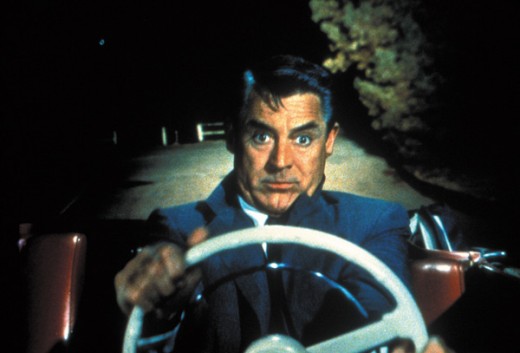
Hitchcock uses the lies and the alcohol consumption against Thornhill throughout the film. The most striking example is after he’s given drink and forced to drive drunk to escape from his would be killers. While we, the viewer, know that he’s been forced to drink against his will and was forced to drive inebriated to escape, no one believes him. Certainly the story would be fantastical and hard to believe but his mom especially is skeptical because of his propensity for drink and history of stretching the truth. Throughout the film you see Thornhill struggling to make others believe him (the murder at the UN is another example) and this is set up by the first few minutes of the film.
Question 2:
If "Rear Window" is about tight framing, reaction shots and, therefore, "being stuck", it seems that "North by Northwest" is a film about scale, tracking shots, angle shots and constant movement. Discuss one scene where Hitchcock uses tracking and angle shots to create this affect.
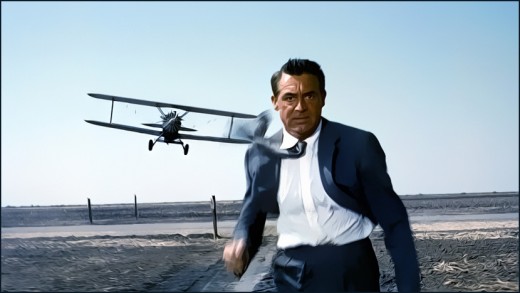
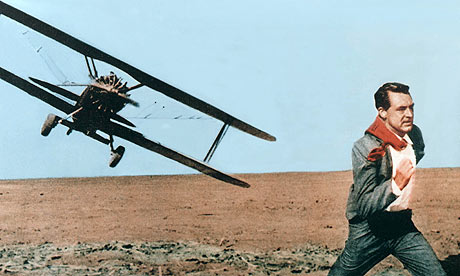
Having seen several Hitchcock films prior to North by Northwest , I was struck by how, even though the film oozes Hitchcock, the way it’s filmed is drastically different from other films. Whereas films like The Birds, Rear Window and Psycho use a lot of close and tight in shots, North by Northwest relies a lot on long tracking and high angle shots. The shots of the train moving along the track and the scene where the crop duster chases Roger Thornhill, these scenes are quite impressive because of the high scope of the shots. In the case of the train shots, they show the hugeness of the train and the length of the journey. With the crop duster, it shows the aloneness of Thornhill and heightens his vulnerability.
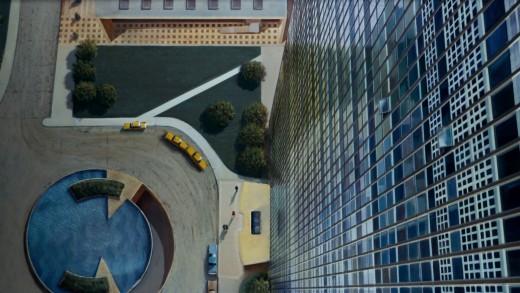
The shot, however that instantly struck me was the huge overhead shot of Thornhill escaping from the UN. To accomplish this birds eye view, Hitchcock placed the cameras way above the action, probably on a crane or fixed object on the building and pointed down at the "tiny" actor running across a concrete pathway. The shot makes Thornhill appear antlike as he escapes the UN, slowing down his escape and pointing out his vulnerability, contrasting with the sharp sense of self importance that Thornhill’s character seems to possess. It was very striking to see him scurry along the long corridor from the UN to the street to a waiting taxi as he fled the scene of a murder he did not commit. It was a brilliant usage of scope and scale that furthered the emotional and psychological state of Thornhill at that point in the film, and thereafter.

![North by Northwest - Special Edition [VHS]](https://m.media-amazon.com/images/I/51umnv-qHDL._SL160_.jpg)
Question 3. As light and entertaining as "North by Northwest is", what are some of the specific scenes in the film that have a darker aspect?
Any time you’re dealing with death and murder and mayhem, you’re going to, by nature, have a dark aspect. There weren’t many overtly dark scenes in this film but I did find the scene where Thornhill was driving the car drunk after escaping from his murderers to be somewhat dark. He was drunk and endangering his own life and the life of others. It was not filmed in a humorous or light manner and, of course, the scene took place at night, so, it was naturally dark.
The darkest scene, though is the sinister and infamous crop duster scene. The wrongly accused Thornhill is set to be murdered but not with a bomb or a stabbing or a gun but by an airplane. Death from above. Even though the plane is fast, it is a slow and terrifying attack. It’s dark in its deliberate uniqueness. It’s dark in the fear scene on Thornhill’s face and is made even more dark by the setting of a vast landscape in the middle of nowhere.
The fact that this scene occurs in broad daylight makes it even more sinister.

Works Cited
Dick, Bernard F. The Anatomy of Film. Boston/New York: Bedford/St. Martin's. 2010 PRINT
North by Northwest. Dir. Alfred Hitchcock. MGM. 1959 FILM